
Story (Spoilers!)
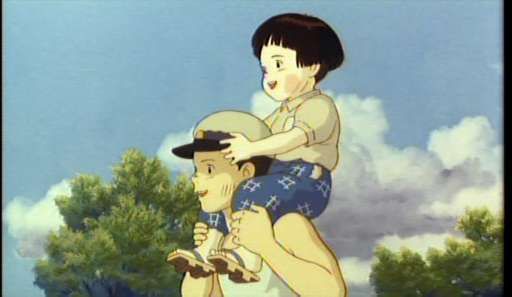
The film opens with a shot of a young man dying of starvation in a subway station, his body being prodded and examined by sanitation workers and pedestrians as they pass. Comments about how disgusting the body is are made in passing as his spirit watches over him. This spirit is that of Seito, a teenager, who leaves the subway station to meet his toddling sister Setsuko in a field of fireflies, boarding a train together and vanishing. We then flash back to the events surrounding this. Seito and his sister live in Kobe, which is being constantly barraged by American firebombs: flaming canisters traditionally filled with magnesium, phosphorus, napalm, or thermite. In agonizing detail, we see that these burned the siblings’ mother to death. Seito attempts to hide this from Setsuko, but as we find out later, it is revealed to her by their aunt. In the wake of Kobe’s total destruction, the two move in with their aunt who, when rations decrease, berates them constantly for not working or otherwise disappointing her. They move out, finding refuge in an abandoned bomb shelter surviving on rice. Seito shares a touching moment with Setsuko, gathering fireflies to release in the shelter for light. The next morning, these fireflies are dead and Setsuko shares that she knows her mother is dead as she buries the fireflies. They soon run out of rice, forced to steal food from farmers, for which Seito is severely beaten. Setsuko quickly becomes malnourished, as a doctor states with no intention of helping. Seito withdraws all of the money from his late mother’s bank account to buy Setsuko some food, in the process finding out that his sailor father has also been killed. When he returns with the food, he finds his sister gaunt and hallucinating. He feeds her a piece of watermelon. She thanks him, falling asleep to never wake. He cremates her body and places some of her ashes into the candy tin she carried around. The film flashes forward again to their spirits surrounded by fireflies, sitting together on a bench overlooking modern-day Kobe.
My Review (Very Minor Spoilers)
There is no way to accurately describe the feeling of emptiness that this film conveys, but I will try. Grief does not exist, not for them. Not for those who survived endless nights of relentless slaughter. Early in the film, we see rooms filled with people who have been mutilated by firebombs. Napalm is, along with Agent Orange and landmines, humanity at its most vile. It is impossible to extinguish and, when in contact with human skin, impossible to remove without removing the skin (for example, this is shown in grisly detail in the film We Were Soldiers). We get shots of skinned bodies, skinned earth, and every emotion felt by the families that lived there and lost everything is laid bare as well. We see the bombing, and with a haunting stillness we see the aftermath. Even though we never lived there, we reach a sense of sympathetic paranoia almost immediately, expecting any still moment to suddenly erupt in catastrophic violence. Combining this with being confronted with the characters losing someone close is immensely effective. Director Isao Takahata understood how effective this would be, and further puts us into the minds of these people. Because of this paranoia and this relentless barrage, there is no time to grieve. Any major loss, especially the critical one at the end, is quickly moved past into the next sequence. With surgical precision, Takahata wounds us with a deeply emotional loss, and moves past it. We have to because they had to. There is a death late in the movie that a character responds to with a simple statement, and the movie keeps going. There is no pause. There is no time to be sad. Despite this death being truly and completely soul-rending, we have no time to grieve because we, like those who lived there, have to move on instantly. When food isn’t guaranteed and surviving the night is uncertain at best, there is no time to pause to come to terms with loss. It is a hollowing feeling. The victims of the atrocities of war had no time to cope. They had to pack up and move without attachment, or they were killed.
Symbolism is crucial to this film. Setsuko plays with ants carrying food, but in a more important scene she digs a mass grave for her dead fireflies. With the ants, we recall earlier scenes of people digging up food they buried to save it from bombing. They, without homes and without certainty of survival, pack their food from underground shelter to underground shelter, like ants. As though they have no purpose in life other than to pack food. Their purpose was stripped from them. With the fireflies, and the namesake of the movie, fireflies represent humans on a more emotional level. Humans, for Takahata, are imbued with a light, some spark of life or hope that we carry from childhood through life. For the countless Japanese citizens killed in air raids, their lights were snuffed out and their carcasses tossed into mass graves as though they never had that spark. As though they were just bugs. She respectfully buries them, marking it with a stick, and the grave is disrespected by more affluent children running around to have fun. They are ignorant of the small-scale tragedy and treat it with disrespect, symbolic of the allied powers that remain willfully ignorant, or simply careless of the massive tragedy they caused. As the children run away, we cut to a shot of the siblings, ragged and starving, standing over the grave. They are the fireflies. They are the victims of this.
War is the easiest theme to make movies about. I, admittedly, am a sucker for clever antiwar messages in film. But Grave of the Fireflies isn’t antiwar. It’s reality. It’s not antiwar in the same sense as The Thin Red Line or Princess Mononoke, using real or imagined wars to make a statement about its impact on nature or humanity. Rather, this film serves to depict reality. War is between governments, fundamentally, but real, innocent human beings pay the price. These two children lost everything to war. They weren’t a part of it. They weren’t the ones that bombed Pearl Harbor. Seito was barely alive when the war started, and Setsuko was born during the war. Yet they were the ones who paid the price. This film serves to force us into their lives. We are forced to experience the sorrow they experienced; to feel the fear they felt; to hear an airplane above and instinctively drop to our knees to accept our fate, regardless of whether it’s dropping bombs; to feel two or three major losses as though we were there. But we weren’t. We feel the agony of a select few, but this agony is shared across an entire nation. There are countless Seitos and Setsukos whose stories we will never hear. Therefore we are allowed to move past it and write it into history books, but never truly understand the pain they went through. Japan went through an indescribable human tragedy and this film tells us that we can’t treat it as anything else. The effects of it will live as long as Japan does.
Every single aspect of this film is flawless. Top to bottom, it hurts. It’s as deep as it needs to be to tell an effective story of human loss. We were on the winning side of the war, but we feel this film as though we weren’t. This is an absolutely vital film in every single way, the single greatest war movie I have seen. No it’s not “exciting” or “fun” or anything else we expect from some brainless Hollywood war movie. There is no side to cheer for. This is war. There is no happiness when people are being slaughtered. There is no cheering for victory when it comes as a result of an insurmountable tragedy. No matter where you live, no matter what gets your country into a war, no matter what, you are not the good guy. There is no good guy in war; there are only sides whose crimes are unequal. There is only loss. This film shows that.
For some clarity on my ratings, over the last three or four years I have watched and rated 1,124 movies as of today. I don’t give out high scores freely. It takes a lot to make me fork over a 9; and flawless technical and philosophical precision, something truly monumental, to make me give out a 10. I see it as a mark of being a masterpiece, and there have been so few of them across history. Some examples would be 2001, Persona, Dekalog, or Solaris. I seek them out in every film class I take, as well as my own viewing, so there is always a chance I will give one out in a class but it isn’t likely. Therefore out of that 1,124, I have given 16 perfect scores.
This is one of them.
10/10


 Hunter's Blog